

Behind every sourcing delay, every failed supplier consolidation, and every missed rebate, there’s usually one culprit: poor quality supplier records.
The same supplier might show up under five different names across your systems, each with different tax IDs, addresses, and business units. And when no one knows which version is right.
That’s why entity resolution is no longer a ‘nice to have.’ When combined with corporate hierarchy mapping, it reveals relationships, risks, and opportunities that would otherwise remain hidden.
What Is Entity Resolution?
Entity resolution is the process of matching each supplier record to a unique, verified legal entity. That means aligning inconsistent names (like “ABC LLC” vs. “ABC Inc.”), cleaning up outdated information, and resolving duplicates across procurement, finance, and compliance systems.
But the real magic happens when this clean foundation is linked to a mapped corporate hierarchy and shows which suppliers are subsidiaries, parents, or affiliates of each other.
Together, entity resolution and hierarchy mapping create one unified supplier record. And with that, the procurement team finally gains a single source of truth.
Why It Matters: Procurement’s Hidden Data Problem
Most organizations don’t realize how much procurement ROI is lost to poor quality data until it’s too late. Here’s what happens when supplier records are inconsistent:
- Spend is split across duplicate entries, hiding total volume and killing negotiation leverage.
- Compliance risks multiply, as outdated or mismatched records mask supplier certifications and financial instability.
- ERP and S2P projects slow down, consumed by manual supplier remediation and onboarding delays.
- Audit trails break down, leading to errors, rework, and uncertainty.
It’s no surprise that 82% of procurement professionals are not fully confident in the accuracy of their supplier data.
One Supplier ≠ One Record
In a perfect world, every supplier would have one record in your procurement system. That record would be complete, up-to-date, and tied to the correct legal entity, with visibility into the parent company, subsidiaries, and related affiliates.
But procurement doesn’t operate in a perfect world.
In reality, one supplier often shows up as multiple records across systems like SAP Ariba, Coupa, Oracle, and various spreadsheets. Here’s what that looks like in practice:
Let’s say your company sources packaging materials from Johnson Packaging International, a multinational conglomerate with regional branches around the globe.
Here’s how they might appear in your procurement data:
- Johnson Packaging USA LLC
Listed with a U.S. tax ID and a New Jersey billing address.
Shows $2.2M in spend. - JPI GmbH
Based in Germany, using a local VAT number.
Contracted through your EU division with $1.4M in spend. - JohnsonPack Co. Ltd.
Operating in Southeast Asia, billed in local currency.
Onboarded by your APAC team with $850K in spend.
At first glance, these look like three different suppliers. But in truth, they’re all part of the same legal entity family.
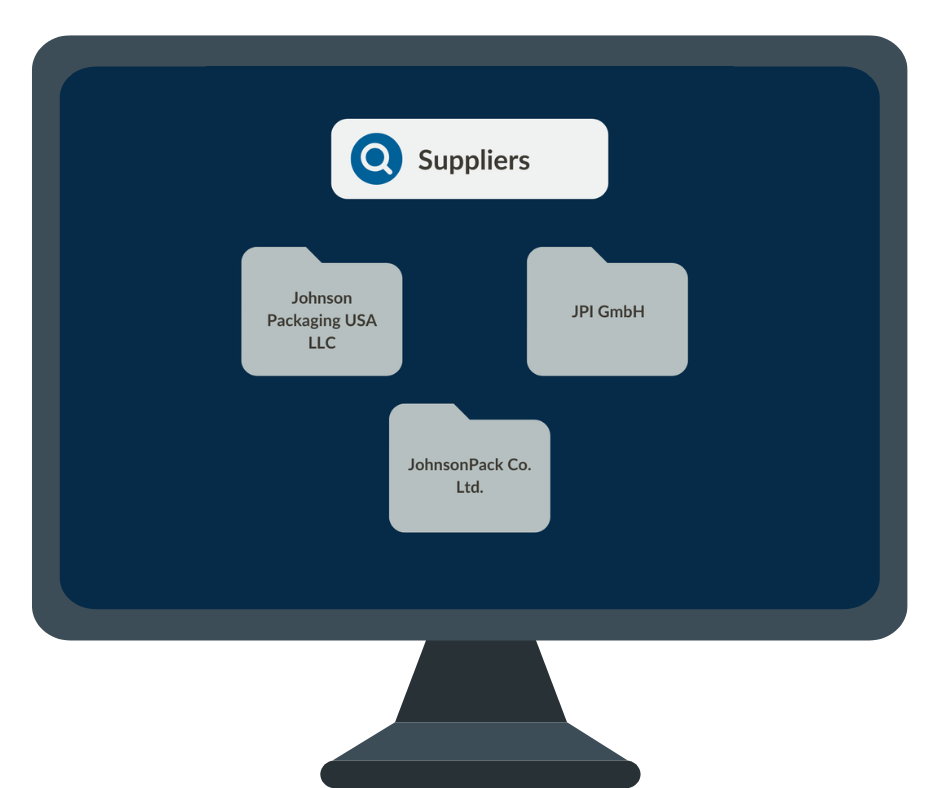
Because these records live in different systems and have different formats, languages, and identifiers, your procurement team can’t see the full picture. You’re missing over $4 million in consolidated spend and the negotiating power that comes with it.
The ROI of Getting It Right
When supplier records are unified under one legal entity, procurement unlocks a new level of performance. Here’s what that looks like in practice:
Spend Visibility and Consolidation
Instead of negotiating five contracts with five “different” suppliers, you realize they’re all subsidiaries of the same parent. That’s leverage.
- Consolidate contracts
- Qualify for volume-based discounts
- Simplify vendor management
Faster, Smoother System Implementation/Migrations
ERP and S2P systems assume your vendor data is clean, but it rarely is. With clean, connected records:
- Duplicate remediation is automatic
- Supplier enablement accelerates
- Go-live readiness improves significantly
Smarter Risk and Compliance Management
With a clear view of supplier relationships, compliance becomes proactive.
- Trace certifications and ownership across the full hierarchy
- Flag risks at the parent and child level
- Improve audit speed and accuracy
Improved Decisions, Faster
Procurement leaders no longer have to reconcile data across finance, legal, and sourcing teams manually. One record means:
- Eliminate guesswork with complete records
- Enable reliable supplier segmentation
- Streamline collaboration across sourcing, finance, and legal
How Entity Resolution Works (at a High Level)
- Match
- Use unique identifiers like tax IDs, registration numbers, and global databases to recognize each entity, even when names, addresses, or local formats differ.
- Use unique identifiers like tax IDs, registration numbers, and global databases to recognize each entity, even when names, addresses, or local formats differ.
- Resolve
- Deduplicate and reconcile supplier data across multiple systems. Clean up incomplete or outdated profiles.
- Deduplicate and reconcile supplier data across multiple systems. Clean up incomplete or outdated profiles.
- Map
- Link records across subsidiaries, parent companies, and affiliates. Maintain full visibility across corporate relationships.
- Link records across subsidiaries, parent companies, and affiliates. Maintain full visibility across corporate relationships.
- Enrich
- Continuously update supplier profiles with key attributes like diversity status, ownership type, and certifications, without relying on supplier portals.
- Continuously update supplier profiles with key attributes like diversity status, ownership type, and certifications, without relying on supplier portals.
Building a Scalable Foundation
Entity resolution isn’t a one-time fix, it’s a data strategy.
It lays the groundwork for:
- Procurement transformation and system consolidation
- Trusted, self-service supplier insights
- Strategic supplier relationship management (SRM), where even a 3.2% savings uplift can translate into millions
And the benefits extend far beyond procurement. Finance, compliance, and legal all rely on that same supplier data foundation to function efficiently.
Getting Supplier Data Right, For Good
In procurement, the smallest data problems often cause the biggest ROI leaks. But with the right foundation, anchored in entity resolution and supported by hierarchy mapping, procurement can reclaim control.
One supplier. One record. Endless clarity. That’s the power of getting it right from the start.

Kelsey McAnally is a Strategic Account Manager at TealBook.